Start with an idea
Give a clear title to the business idea you want to analyze.
A self-assessment tool for bootstrapped startups
The Bootstrapping Canvas helps you test how well a business idea fits a bootstrapping strategy.
mark, connect the area, and find what needs attention
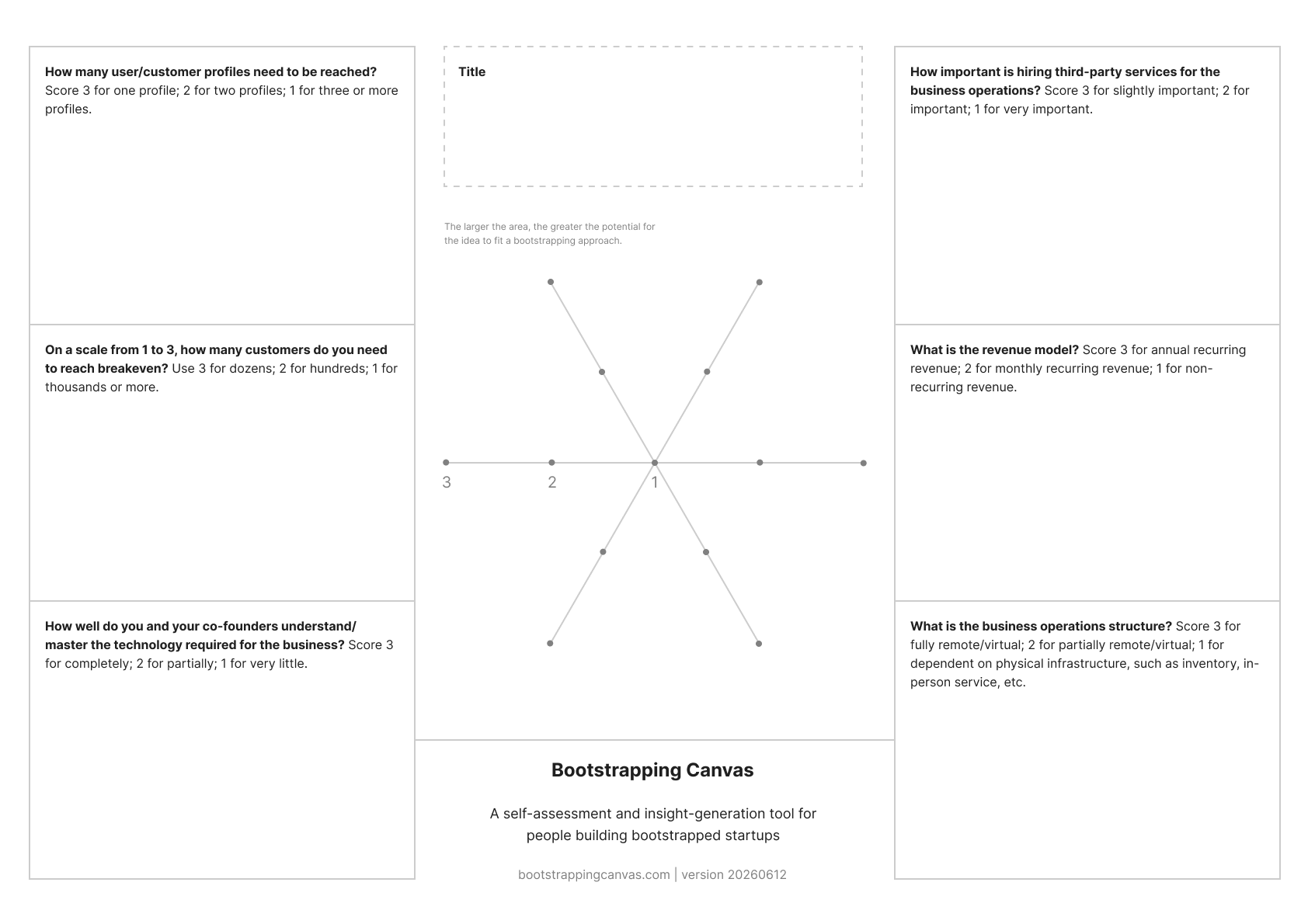
Bootstrapping is a way to start and grow a business with the smallest possible amount of external resources, using founders’ capital, early customers, cost control, and operational creativity.
Some ideas require several different audiences, significant upfront investment, many suppliers, complex physical operations, or thousands of customers before reaching break-even. Others can start leaner, with fewer customer profiles, remote operations, recurring revenue, and technical knowledge inside the founding team.
the canvas helps make this conversation visible
How it works
Give a clear title to the business idea you want to analyze.
Each question receives a score from 1 to 3.
Transfer your answers to the axes in the central diagram.
A larger and more balanced area suggests stronger fit with bootstrapping.
3 represents the most favorable condition for bootstrapping and 1 represents the least favorable condition. The area of the chart does not provide a final answer: it helps reveal strengths, weaknesses, and questions that deserve deeper analysis.
The six dimensions
3 for one profile · 2 for two · 1 for three or more.
The fewer audiences you need to connect, the simpler initial acquisition tends to be.
3 for dozens · 2 for hundreds · 1 for thousands or more.
The fewer paying customers needed to sustain the operation, the lower the pressure on cash flow.
3 for complete · 2 for partial · 1 for very little.
When the founding team masters the core technology, the first version can start with fewer external dependencies.
3 for slightly important · 2 for important · 1 for very important.
Lower dependency on suppliers tends to reduce costs, delays, and operational complexity.
3 for annual recurrence · 2 for monthly recurrence · 1 for non-recurring revenue.
Recurring revenue increases predictability. Annual plans can bring cash forward.
3 for remote/virtual · 2 for partially remote · 1 for physical infrastructure.
Digital or remote operations tend to require less infrastructure, inventory, and initial capital.
Examples
High potential
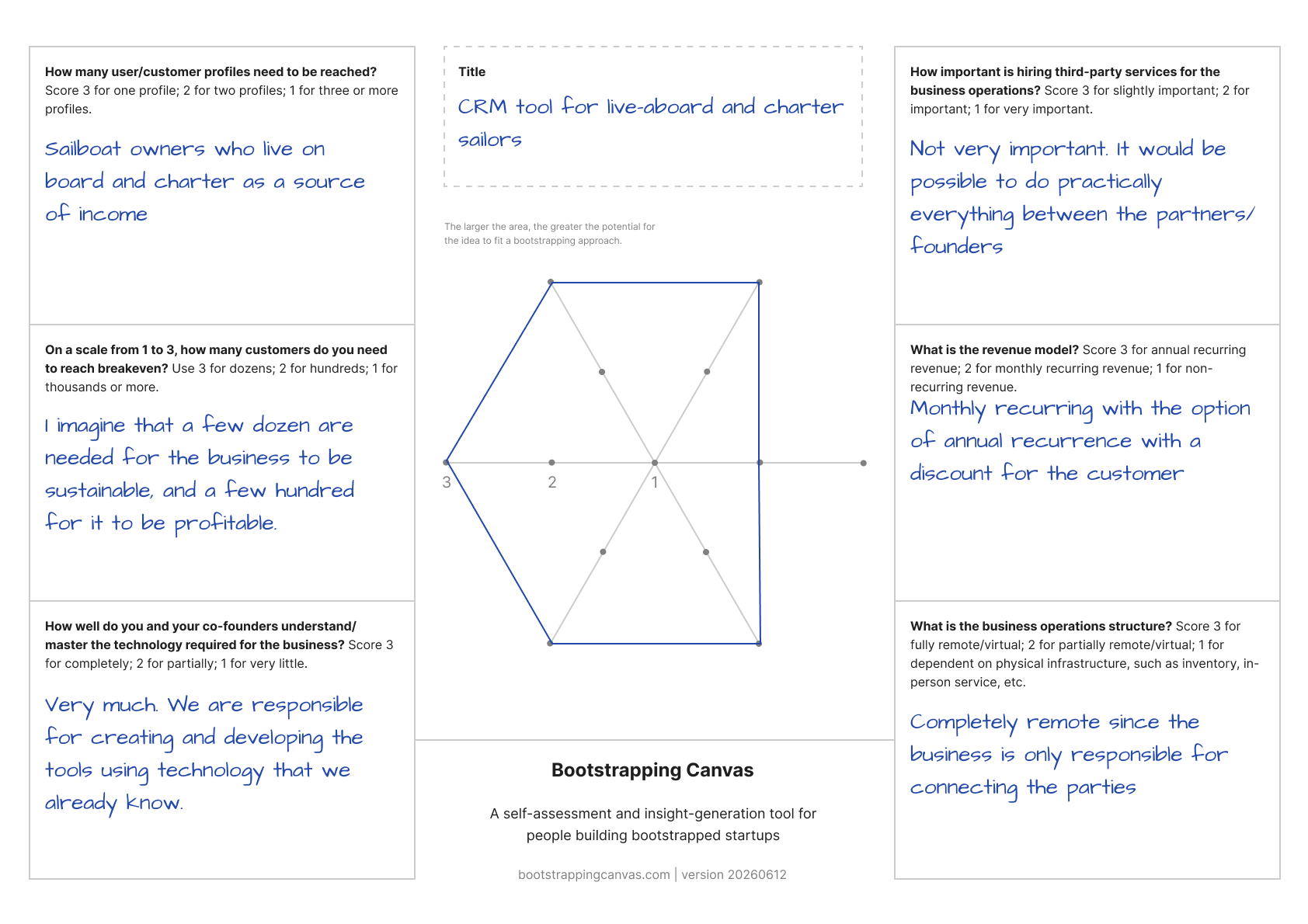
improvement point: test annual plans to bring cash forward
The initial audience is well defined. The operation can be remote. The founders master the required technology. Hiring third-party services is not very important. The product could start as a simple SaaS, with monthly recurring revenue and the possibility of annual plans with a discount.
| Customer profiles | 3 |
|---|---|
| Customers until break-even | 3 |
| Technical mastery | 3 |
| Third-party dependency | 3 |
| Revenue model | 2 |
| Operating structure | 3 |
Low potential
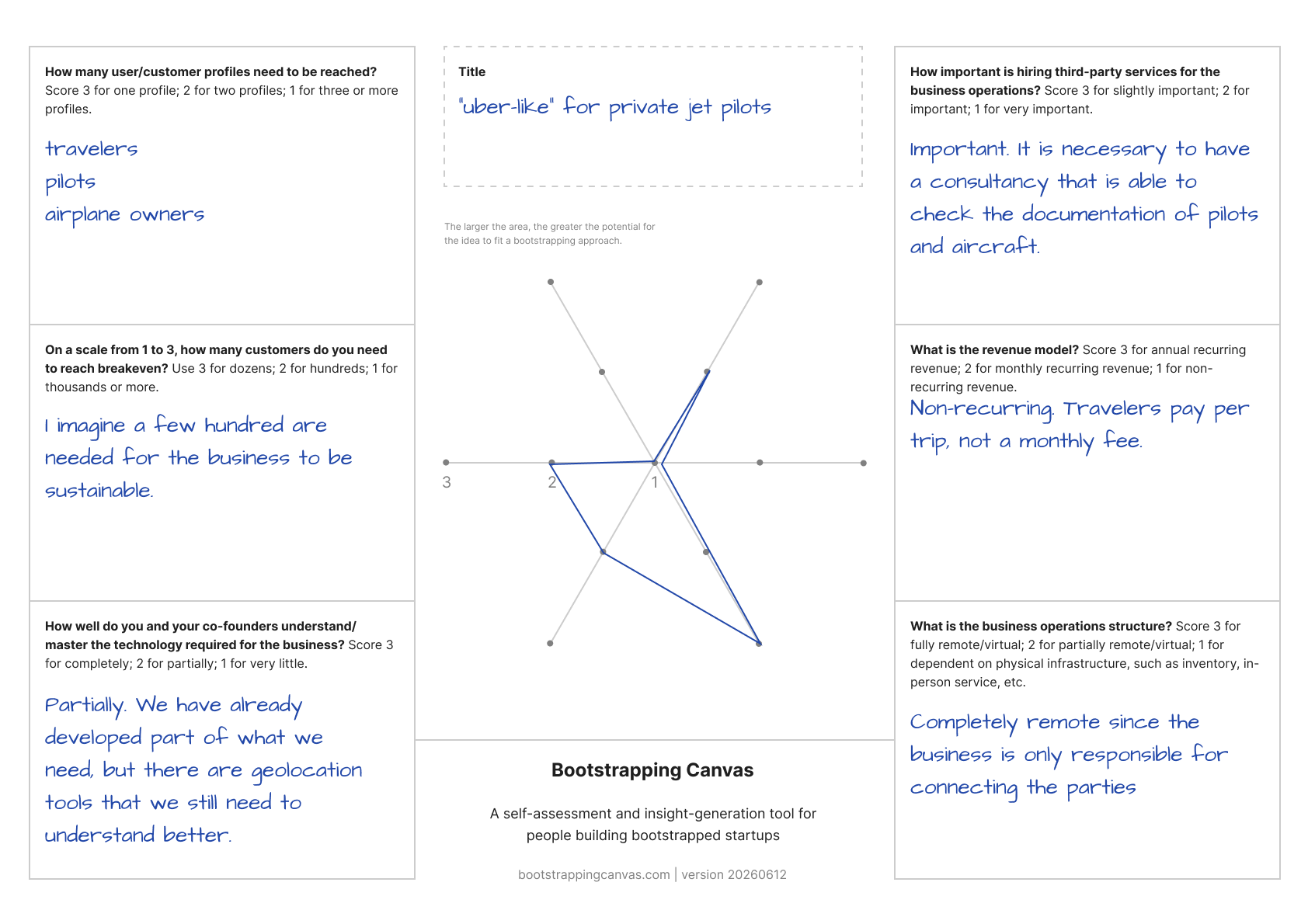
it does not invalidate the idea; it suggests a need for more validation, capital, and partners
The idea depends on multiple user profiles, requires trust between several parties, may need regulatory or documentation checks, has non-recurring revenue, and depends on a larger volume of transactions to become sustainable.
| Customer profiles | 1 |
|---|---|
| Customers until break-even | 2 |
| Technical mastery | 2 |
| Third-party dependency | 1 |
| Revenue model | 1 |
| Operating structure | 3 |
The Bootstrapping Canvas can be used in entrepreneurship activities, practical training exercises, university courses, innovation programs, and conversations between founders.
In a 30 to 60-minute activity, each group can choose an idea, review its business model, answer the six questions, mark the chart, and discuss what would need to change to make the idea more suitable for bootstrapping.
Limitations
The Bootstrapping Canvas was created between 2020 and 2021 as my final paper for the MBA in Business Management at USP/ESALQ. It has not been empirically validated and should be used as a self-analysis and insight-generation tool.
It does not replace economic and financial analysis, market validation, customer research, legal analysis, risk analysis, or detailed financial planning.
Just as the Business Model Canvas does not replace a complete business plan, the Bootstrapping Canvas is not intended to replace a detailed feasibility study. Think of it as a preliminary business design tool.

Except where otherwise noted, the Bootstrapping Canvas and this website are licensed under a Creative Commons Attribution-ShareAlike 4.0 International License .
You are free to share and adapt the material, including for workshops, classes, and training sessions, as long as you give appropriate credit and distribute adaptations under the same license.
RIGOLINO, Bruno. Bootstrapping Canvas. Versão 20260612. 2026. Disponível em: https://bootstrappingcanvas.com. Acesso em: [dia mês ano].
Rigolino, Bruno. “Bootstrapping Canvas.” Bootstrapping Canvas, version 20260612, 12 June 2026, https://bootstrappingcanvas.com. Accessed [day month year].
Rigolino, Bruno. “Bootstrapping Canvas.” Bootstrapping Canvas. Version 20260612. June 12, 2026. https://bootstrappingcanvas.com.
@misc{rigolino2026bootstrappingcanvas,
  author       = {Rigolino, Bruno},
  title        = {Bootstrapping Canvas},
  year         = {2026},
  howpublished = {\url{https://bootstrappingcanvas.com}},
  note         = {Version 20260612.},
  license      = {Creative Commons Attribution-ShareAlike 4.0 International}
}